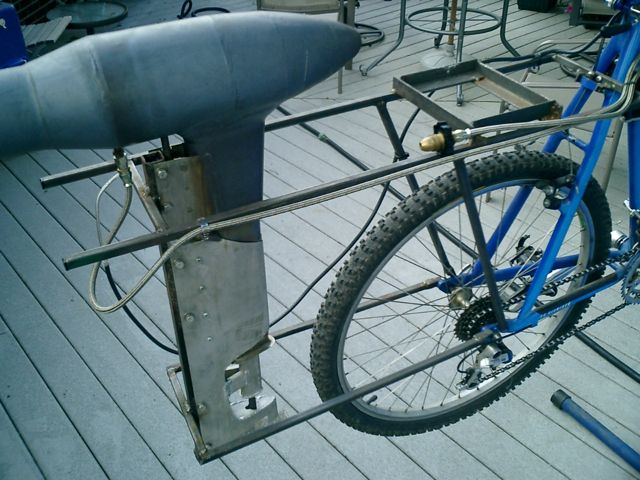
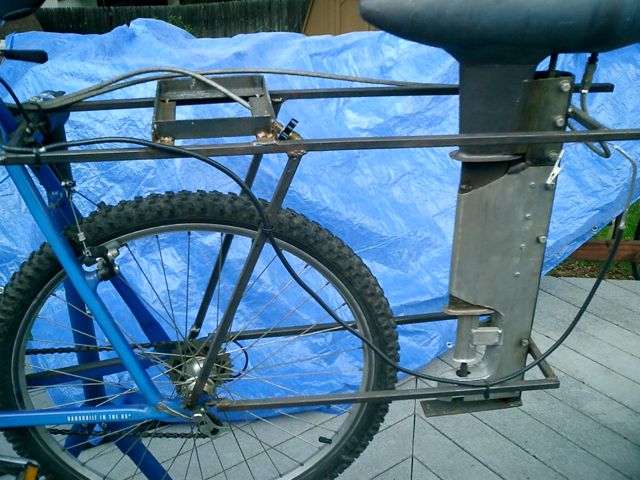
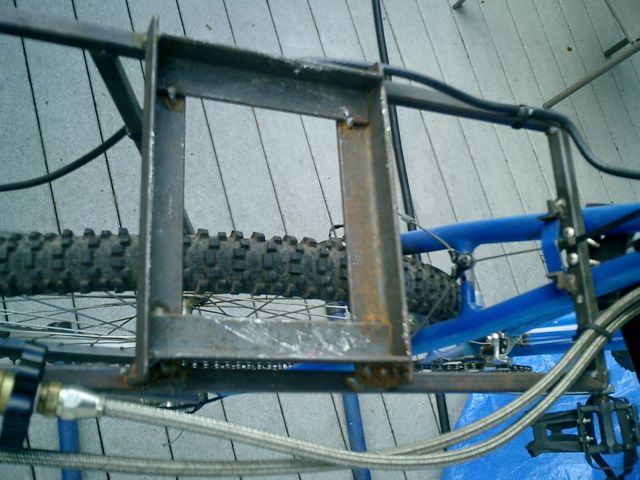
Here are some closeup pics of the engine mount:
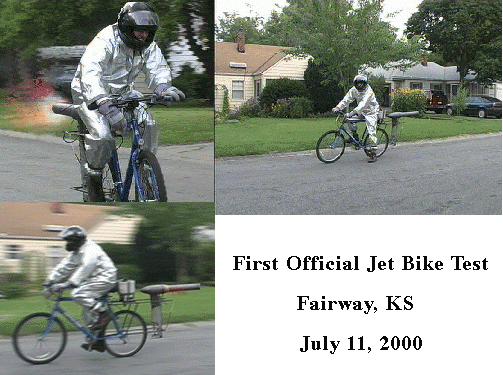
Jetbike Test Movie - July 2001, Golden, Colorado
Kart History:
On November 8,1998 the kart reached approximately 15 miles per hour. Speed
measurements were made with a GPS.
In early October, 1999, the Kart was fitted with a piezoelectric ignition
system, replacing the troublesome "model T" ignition coil. A nitrogen tank
and
regulator was fitted to the kart, improving tank pressure.
On October 23, 1999 the kart was tested with the improvements. The
"barbeque
grill tank" was replaced with a "forklift" tank which has both vapor and
liquid
ports. Top speed was still only 15mph, but reliability was increased
greatly.
The slow speed is attributed to the excessive weight of the tanks and the
kart
itself (low power-to-weight ratio). Anyone attempting to build a
Jet-Powered
Go-Kart is advised to choose a larger jet engine.
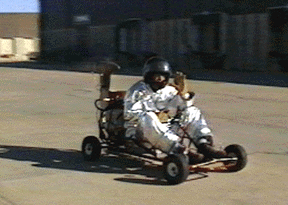
The power plant is a Gluehareff G-2-20 pressure jet engine. This jet
weighs
5.5 pounds, has no moving parts, and is fueled with propane, generating 20
pounds of thrust.
The propane tank contains 20 lb of fuel, and additionally pressurized to
280
PSI with nitrogen.
The Jet was purchased assembled from Vortech, Inc. The Kart was purchased
from
Fairfield motor sports in Independence, Mo. Our engineers designed,
constructed, and installed fuel and ignition
systems, as well as a suitable mount for the engine.
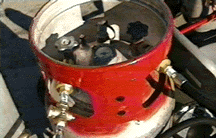 Here is the tank. Notice the check valve on the right. |
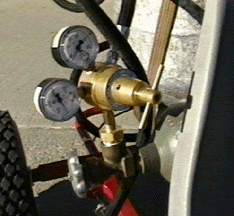 The inert gas regulator has gauges which show nitrogen tank pressure as well as propane tank pressure. |
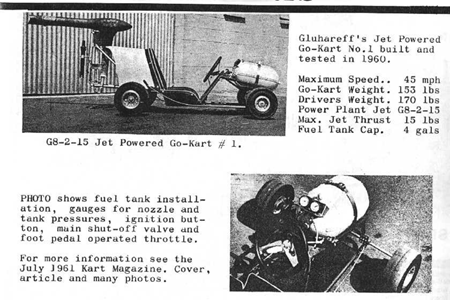
Here is a reprint from the "G-2 Technical Handbook" showing a similar
jet
go-kart built by the jet's designer, Eugene Gluehareff